


Trip Introduction
Overview of Kanchenjunga Circuit Trek- 18 Days | Itinerary | Cost | For 2025/26
A certain amount of awareness in you is reflected by your desire to be in the existence of Kanchenjunga. In addition, there is a strong potential that interest in the Kanchenjunga Circuit Trek will increase significantly. Its realization and transformation allow for recreation, joyness, enjoyment, and pleasure.
In local terms, Kanchenjunga denotes “basic awareness.” Interest as a whole awareness realizes joyful wholeness, a high state of recreation qualitatively. The notion of Himalayan wisdom (awareness) is flexibly applied to transform interest in you to be in Kanchenjunga’s existence toward joyful wholeness.
The Kanchenjunga Circuit Trek takes you through the landscapes and from a low loop of the Kanchenjunga massif to pine forests at higher elevations, showing a magnificent mountain range in the Kanchenjunga region. Consider the majestic Mount Kanchenjunga panoramic views and their astonishing existence. As you pass through the remote villages, your level of awareness assists you in discovering the inner strength of the surroundings.
Kanchenjunga is also popularly known as the “Sleeping Buddha“. Kan, Chen, and Jungha denote the head, belly, and knee. So you may see Buddha sleeping peacefully if you can simultaneously see all three of these peaks. This hill is sometimes referred to as the Sleeping Buddha because of this.
By following your inner, transcendent need to be in the Himalayas, we guide you to the Kanchenjunga Circuit Trek. Our recommendations are meant to help you pursue joy, bliss, and excitement.
Kanchenjunga Circuit Trek Route Map
Are you wondering about the map of the Kanchenjunga trek? If you click on the infographic image below, you will see the route map of Kanchenjunga. The Kanchenjunga Circuit Trek distance is 18 days, starting with the adventurous flight to Bhadrapur and driving to Taplejung. The Kanchenjunga Circuit trek distance from Kathmandu is about 220 kilometers. Then your trek starts to Chhiruwa, Japantar, Ghunsa, Khambachen, and finally to Pangpepa, and then back to Ghunsa, Steam, Yamphudin, and Illam to Kathmandu. You will also see the extension route in the Kanchenjunga region on the map. Upon your interest, we can also use other branch routes for a more exciting view.
Is Kanchenjunga Circuit Trek difficult?
Kanchenjunga in Nepal is classified as a challenging trekking location. By challenging, we mean that there are numerous mountain passes to cross while experiencing challenging ascents and descents. Also, this trek is difficult because of the duration you have to invest in it. For more than two weeks, you will be traveling through small communities in rural areas.
You have had enough time to acclimate during the trek, but we still ask that you start getting in shape three months before the trek. The harsh, unpredictable weather and AMS (acute mountain sickness) are the major problems with this climb. Stay hydrated, and don’t worry much, as your guide is well-qualified to manage all emergencies and extreme circumstances.
Kanchenjunga Circuit Trek Permit
You will need two permits to enter the Kanchenjunga Area. Kanchenjunga Conservation Area Project Entry Permit (KCAP) and a Restricted Area Entry Permit for the trail in Tapethok and Yamphuding VDCs.
The procedure for a restricted area entry permit could take longer than two hours. Additionally, it can only be used once the group has arrived. There is no process for advanced reservations, and each group must consist of at least two trekkers. A guide certified by the government must lead the group.
Note: In most cases, while preparing official paperwork, you will be required to submit passport-size photos and a copy of your passport. So, be sure to bring at least 8–10 passport-size photos. We will complete all legal requirements and acquire all required permits for your trip.
Itinerary of Kanchenjunga Circuit Trek- 18 Days | Itinerary | Cost | For 2025/26
Today, we will prepare the necessary permits for your journey, while also offering you the flexibility to enjoy some sightseeing if you wish. The day begins at around 9:00 AM when the team management meets you to collect your original passport, which is required for processing the trekking permits. This step is essential to ensure all legal formalities are completed smoothly.
While the team handles the paperwork, you have the option to spend the day at leisure, exploring the local attractions, immersing yourself in the culture. Later in the day, at approximately 5:00 PM, your guide will meet you at your hotel to return your original passport along with the necessary permits, ensuring everything is for the trek ahead. This day strikes a perfect balance between administrative preparations and the opportunity to enjoy the region’s beauty at your own pace.
Your adventure begins early in the morning as your guide come to pick you up to the domestic airport. You will soar above Nepal’s breathtaking landscapes, flying over lush green hills and winding rivers. It will be a short 40–45-minute flight before landing in Bhadrapur, Jhapa.
From there, your journey continues by road as you ascend toward the picturesque hills of Ilam. The scenic drive takes you along winding mountain roads, passing through charming villages and vast tea gardens, including the famous Kanyam. This is one of Ilam’s most beautiful areas. The weather here can change unexpectedly, adding to the region’s mystical charm. You’ll stop at a cozy guesthouse in Phikkal for a short break, where you can relax and enjoy the serene surroundings.
You will arrive in Taplejung by late afternoon. This town is a tranquil hill surrounded by stunning landscapes. Here, you can visit ancient Buddhist gompas (monasteries), where butter lamps have been burning continuously for over 400 years. After exploring the town, we will be back to the hotel, resting up for the next leg of your journey.
Today’s journey is an adventurous and rugged drive from Taplejung to Sekathum. Sekathum village is a remote settlement in the lower Kanchenjunga region. The route is entirely off-road, taking you through challenging terrain alongside roaring rivers and dense forests.
We will reach Sekathum after 8-9 hours of Jeep ride in the offroad. Sekathum is a tiny, rustic settlement with just one basic teahouse serving as the only accommodation.
Teahouse Facilities in Sekathum:
- Basic Lodging: Simple wooden beds with thin mattresses; blankets may be provided, but carrying a sleeping bag is advisable.
- Electricity: Lighting is via solar lamps or candles.
- WiFi or Mobile Network: Expect complete disconnection from communication networks.
- Hot Showers: Bathing options are limited to cold river water (if available).
Food Options: Simple Nepali meals, no variety or luxury items on the menu.
Today marks the fourth day of your Kanchenjunga trek, taking you from Sekathum to Amjilosa. The trail features steep ascents, lush forests, cascading waterfalls, and suspension bridges over roaring rivers. Along the way, you may encounter wildlife like the elusive red panda, as well as yaks, sheep, and local Bhotey dogs.
As you approach Amjilosa, the landscape opens up to reveal terraced fields where locals grow cardamom. The village is a cluster of traditional stone and wooden houses, with prayer flags fluttering in the wind. Yak herders can be seen guiding their animals, and the sound of cowbells fills the air.
Amjilosa Village: What to Expect
Amjilosa is a remote Himalayan village that offers a truly authentic experience, far from modern comforts. As you arrive, you will find just two or three basic teahouses where you can rest for the night. These family-run lodges provide simple accommodation with mattresses, twin shared rooms, and the warmth of a wood stove in the common area. Food options are limited, with meals consisting mostly of dal bhat (lentils and rice), noodles, eggs, and Tibetan bread. Meat is rarely available due to the Buddhist beliefs of the local Sherpa and Gurung communities. But if you are lucky, you might get to try fresh yak milk or homemade cheese.
Life in Amjilosa moves at a slow, traditional pace. There is no electricity with just dim solar-powered lights and charging your devices will cost extra. Hot showers are limited and if you want warm water for bathing, you will have to pay for a bucket of heated water. Toilets are basic, usually outdoor squat-style, so bring your own toilet paper. Despite the lack of amenities, the village has a quiet charm. In the evenings, locals gather around fires. The people here rely on cardamom farming, yak herding, and occasional trekkers for their livelihood. If you are curious, you may even get a glimpse of how they produce yak cheese or dry cardamom for trade during the season.
Staying in Amjilosa is a humbling experience as you can staying away from modern distractions and immerses you in the raw beauty of the Himalayas. The starry nights are breathtaking, the air is crisp, and the simplicity of life here leaves a lasting impression. Just remember to carry enough cash, pack warm layers, and embrace the adventure of off-grid living.
Leaving Amjilosa, the trail gradually ascends to the stunning views of the western face of Kanchenjunga. The path winds through lush oak and bamboo forests, with several suspension bridges crossing rivers and streams. The weather in this region is highly unpredictable, especially as you approach Gyabla. The route remains narrow, requiring careful footing, particularly during the monsoon season when trails can be slippery.
In spring, the entire trail comes alive with vibrant rhododendron blooms, adding a splash of color to the dense forest. The river remains a constant companion, flowing alongside the path until you reach Gyabla. If you are lucky, you might even spot a red panda in the wild. The journey is dotted with prayer flags, small streams, and more suspension bridges before arriving at Gyabla. This is a small settlement that functions more as a teahouse stop than a traditional village.
Teahouses in Gyabla
Gyabla is a remote stop with very basic facilities. There are three teahouses available, all offering simple accommodations and meals. Since the area is extremely isolated, electricity and WiFi are unavailable, and services are minimal. The teahouses provide basic lodging (shared rooms), hot meals (typically dal bhat, noodles, or simple Tibetan bread), and a warm place to rest. Given the rugged nature of the Kanchenjunga trekking route, Gyabla serves as a crucial resting point before continuing further into the mountains.
The trek from Gyabla to Ghunsa takes you through one of the most scenic and culturally rich sections of the Kanchenjunga Circuit. The day begins with a gradual ascent through dense forests, crossing multiple suspension bridges over roaring rivers. Unlike larger iron bridges, many smaller streams are crossed via handmade wooden bridges, constructed by local villagers. The weather remains unpredictable, shifting quickly between sunshine and mist, so proper layers are essential.
After a few hours of walking, you will reach Phale which is a Tibetan refugee village established decades ago. Here, you can stop for lunch and interact with the locals, gaining insight into their unique culture. From Phale, the trail becomes steeper as you approach Ghunsa. The final stretch rewards you with breathtaking views before arriving in Ghunsa after about 5-6 hours of trekking.
Ghunsa is a well-developed village with essential facilities, including a school, health post, and police checkpoint. The village consists of around 30 traditional houses, blending into the rugged Himalayan landscape. As a key stop on the Kanchenjunga route, Ghunsa offers better amenities than previous stops. You will able to stay in comfortable place before heading higher into the mountains.
About Ghunsa Village
Ghunsa is a significant stop along the Kanchenjunga trekking route, offering more amenities compared to smaller settlements like Gyabla. This picturesque village features around 30 local houses, a primary school, a police checkpoint, and even a basic health post.
Ghunsa offers better facilities than many other stops along the Kanchenjunga trek. You will see around 10 teahouses available. These lodges provide basic yet comfortable accommodations, including:
- Electricity (usually at an extra cost)
- WiFi (paid service in most places)
- Hot showers (via electric or gas geysers)
- Firewood heating
This village is a key stop for acclimatization, especially for those heading toward higher altitudes like Kanchenjunga Base Camp or the Lhonak Valley. The blend of local culture, improved facilities, and breathtaking mountain views makes Ghunsa a memorable part of the trek.
After a restful day in Ghunsa, the trail leads further into the remote Kanchenjunga region, gradually moving away from the main mountain range. Today’s trek offers breathtaking views of Jannu Himal (Kumbhakarna) as you walk along a gentle path through a stunning green glacier valley. The journey begins with a scenic hike past mani walls and alongside pristine rivers, with a mix of gradual ascents and descents.
The first stop is Chhermalung (3,740m), a small resting point located 3.8km (about 1.5 hours) from Ghunsa. After a short break here, the trail continues to Labuk (3,797m), where a few basic teahouses serve lunch and breakfast. Following a meal and some rest, the trek resumes toward Khambachen (4,050m). This section is challenging, with landslide-prone slopes and steep, rocky terrain resembling the Tilicho Lake route in Annapurna.
Along the way, you will cross multiple suspension bridges and rivers, with the alpine landscape growing more dramatic. If you are lucky, you might spot blue sheep or even the elusive snow leopard in the high cliffs. After 5–6 hours of trekking from Ghunsa, you will finally arrive in Khambachen.
Teahouses in Khambachen
Khambachen has very limited facilities due to its extreme remoteness. There are only four teahouses in the area, all offering basic lodging and meals. Electricity, WiFi, and mobile networks are unavailable, making it a true wilderness experience. Some teahouses provide bucket hot showers and hot drinking water, but these come at an extra cost. The food menu is limited, typically featuring local dishes like dal bhat, noodles, and Tibetan bread. Since amenities are scarce, you should be prepared for a rugged stay before continuing toward higher altitudes like Lhonak or Kanchenjunga Base Camp.
Before tackling the next challenging leg of the Kanchenjunga Circuit, we take a well-deserved rest day in Khambachen to acclimatize and explore the surrounding high-altitude wonders. Rather than rushing ahead, we use this day for a rewarding side trip to Janu Himal (Kumbhakarna) Base Camp. This allows your body to adjust while soaking in breathtaking Himalayan vistas.
Since there are no facilities along the way, we carry packed lunches for the journey. The trail leads through snow-covered landscapes, offering spectacular views of Kumbhakarna (Jannu Himal), the world’s 32nd highest peak. Along the route, we pass a sacred site where the Kirat people perform traditional worship. After spending time at the base camp, marveling at the glaciers and towering peaks, we return to Khambachen for a relaxed evening at our teahouse.
This acclimatization hike not only helps with altitude adjustment but also rewards us with some of the most dramatic scenery of the trek. We will pass through glacial valleys, sacred landmarks, and close-up views of one of the Himalayas’ most formidable peaks.
Today’s trek is one of the most challenging yet visually stunning sections of the Kanchenjunga Circuit. Departing from Khambachen, we follow a rocky, uneven path along the western edge of the Kanchenjunga Glacier. It offers dramatic views of towering ice formations. The trail is scatter with large pebbles and loose rocks, making footing tricky, and passes through landslide-prone zones, requiring careful navigation.
After about 6 hours of trekking, we reach Lhonak (4,756m), the highest settlement on this route. Along the way, we stop at the stunning Khando Waterfall (4,381m), cascading down rugged cliffs. A packed lunch is enjoyed at Ramdang, a cold and windswept resting point where layers are essential.
As we approach Lhonak, the landscape grows more austere, with scattered stone huts marking this remote Himalayan outpost. From here, the views are extraordinary and you can see Wedge Peak, Mera Peak, Nepal Peak, and many more. These snow-capped summits glowing in the evening light.
Teahouses in Lhonak
Lhonak’s extreme altitude and isolation mean facilities are extremely basic. Only four teahouses operate here, offering simple dormitory-style lodging with shared spaces. There is no electricity, or WiFi, emphasizing the raw, off-grid nature of this high-altitude stop.
This day’s trek is physically demanding but is rewarded with unparalleled glacial vistas and a true sense of Himalayan wilderness. Proper acclimatization, warm clothing, and sturdy footwear are crucial for safety and comfort.
Today marks the highlight of your Kanchenjunga adventure as you make the final ascent to Pang Pema (North Base Camp). The journey begins with a trek through Syjango, where snow-covered trails are common during peak seasons. You will then navigate the rugged moraine of the Kanchenjunga Glacier, gradually climbing toward the base camp.
The route is demanding, with steep sections and high landslide risk. But, breathtaking mountain scenery, dominated by the towering Kanchenjunga massif makes every step worthwhile. Also known as Panpema View Base Camp, this remote outpost sits at an elevation of 5,140 meters.
Since there are no teahouses or shops at the base camp, you will carry a packed lunch to enjoy amidst the dramatic Himalayan landscape. After soaking in the awe-inspiring vistas, you will descend back to Lhonak for the night. The entire journey includes exploration time at the base camp which takes 7-8 hours, making this a long but unforgettable day.
Today’s journey takes us downhill from the high-altitude wilderness of Lhonak back to Ghunsa. You will follow a rugged, pebble-strewn trail along the eastern bank of the Tamor River. The descent is relatively easier compared to previous days, offering a more relaxed trekking experience with stunning mountain vistas.
The route passes through Kambachen Village before continuing along the river valley. The landscape gradually transitions from barren alpine terrain to lush forests. The total trekking duration is approximately 7–8 hours, with a comfortable overnight stay in Ghunsa.
This day serves as a peaceful conclusion to the challenging Kanchenjunga Base Camp trek this allows you to unwind and reflect on the breathtaking Himalayan landscapes encountered along the way.
The trek begins as you leave the forests of Ghunsa, gradually transitioning into alpine grasslands with breathtaking mountain vistas. The trail is adorned with colorful vegetation, and as you ascend, the distant Phale village shrinks below. The climb to Sele Le (4,355m) is steady, offering awe-inspiring views of the surrounding peaks.
Sele Le is divided into upper and lower sections, with typically staying at the base camp area. The panoramic views from here are unmatched, making it a must-visit spot on the Kanchenjunga trek. Along the way, you may see tented camps set up by other expeditions. Due to the high altitude, the air is crisp, and the weather can change rapidly, so proper acclimatization and warm clothing are essential.
Teahouses in Sele Le
Sele Le is an extremely remote and high-altitude stop with only two basic teahouses available. Facilities here are minimal and there is no electricity or hot showers, and the food options are simple. A faint NTC mobile network may work intermittently, but connectivity is unreliable. The teahouses provide shared dormitory-style lodging with basic bedding, so carrying a sleeping bag is recommended for extra warmth.
This is one of the most challenging days of the Kanchenjunga trek, requiring an early start from Sele Le. The trail involves crossing three high-altitude passes: first, Sinion La Pass (4,450m), followed by Mirgin La Pass (4,645m), and finally, the toughest, Sinelapche La Pass (4,830m). The steep ascents and descents, combined with thinning air, make this section physically demanding.
Along the way, you will encounter yaks carrying supplies, a common sight in this remote region. A highlight of the trek is the stunning Thanga Lake, whose serene waters reflect the surrounding peaks. After 8-9 hours of strenuous hiking, you will finally arrive at Tseram, a small settlement nestled in the mountains. If weather permits, you will be rewarded with a breathtaking sunset over the Himalayas.
Teahouses in Tseram
Tseram has only two basic teahouses, offering minimal facilities. Accommodations are simple, with shared rooms and basic meals. Be prepared for a rustic experience as there will be no extra amenities, no electricity, WiFi, or heating. The teahouses serve as a crucial resting point before the next day’s push toward Ramche and the Kanchenjunga Base Camp. Given the high altitude, staying hydrated and well-rested is essential for acclimatization.
The day begins with a steep ascent from Tseram (3,870m) to Ramche (4,580m), following a rugged, pebble-strewn path with sections prone to landslides. The trail climbs steadily, offering breathtaking mountain views, and if you are lucky, you may spot blue sheep grazing on the rocky slopes. After about 3 hours, you will reach Ramche, a scenic high-altitude grazing area surrounded by towering peaks.
Since the trek to Ramche is relatively short, you will have lunch here before continuing toward Oktang (Yalung South Base Camp). The hike to the base camp takes less than an hour, following a trail lined with colorful prayer flags along the edge of a glacier. At 4,740m, you will be rewarded with unmatched views of Kanchenjunga’s south face, as well as other massive peaks like Kabru and Rathong. After soaking in the majestic scenery and taking photos, you will descend back to Tseram for the night.
Teahouses in Tseram
Tseram has a few basic teahouses catering to you on the Kanchenjunga route. The accommodations are very simple, with shared dormitory-style rooms and thin mattresses. Due to the remote location, there is no electricity (lighting is typically solar-powered), and no WiFi. Meals are basic but hearty. There will be dal bhat, noodles, or Tibetan bread to help replenish energy after a long day of trekking. Since nights at this altitude can be extremely cold, it is essential to have a good sleeping bag and warm layers.
As you move downward, the landscape shifts into lush sub-tropical forests. This is also the part of the Kanchenjunga National Park, with rich biodiversity and dense vegetation. The trail follows a rugged path, often alongside river valleys, with occasional steep sections.
By late evening, you arrive at Tortong, the only settlement along this stretch. This remote outpost sits near the border region facing India, with the towering peaks of Ladakh visible in the distance. The isolation of Tortong adds to its wild, untouched atmosphere, making it a unique stop on the Kanchenjunga trek.
Teahouses in Tortong
Tortong is an extremely remote location with only two basic teahouses available for trekkers. These teahouses offer minimal amenities with simple shared lodging, basic meals (typically dal bhat, noodles, or Tibetan bread), and a place to rest. There is no electricity, WiFi, or mobile network coverage, emphasizing the area’s seclusion. You should be prepared for a rustic experience, carrying essentials like headlamps, power banks, and sufficient warm clothing. Despite the limited facilities, staying in Tortong provides a rare opportunity to experience the raw, untouched beauty of the Himalayas near the Indian border.
This day’s trek is long and demanding, with challenging terrain, but the dramatic scenery and the sense of remoteness. Proper preparation is key, especially due to the landslide-prone sections and lack of modern conveniences in Tortong.
The trek from Tortong begins with a downhill descent, gradually revealing breathtaking mountain vistas. In the morning, the trail leads towards Lasiya Bhanjyang, a scenic spot where you can take a break and enjoy the surrounding landscapes. After lunch, the path becomes steep and rugged as it plunges into dense forests, with uneven terrain requiring careful footing.
As you descend further, the trail eventually opens up to the vibrant village of Yamphudin. This village is one of the largest settlements along the Kanchenjunga trek. This culturally rich village is an important stop, offering a glimpse into the local Limbu and Sherpa communities. The descent is demanding on the knees, but the lush greenery, occasional waterfalls, and distant mountain views keep the journey engaging.
Teahouses in Yamphudin
Yamphudin is relatively well-equipped compared to other stops on the trek, with three teahouses available. These lodges provide basic but comfortable accommodations, including shared rooms with simple bedding. Unlike more remote stops, Yamphudin offers limited electricity, allowing for device charging, and some teahouses may provide WiFi (though unreliable). Additionally, bucket hot showers are available for a refreshing cleanse after the long descent.
The village also has small shops selling snacks and basic supplies, making it a convenient place to restock before continuing the journey. The warm hospitality of the locals, combined with the improved facilities, makes Yamphudin a welcome stop after a challenging day of downhill trekking.
This marks the final leg of your trek. After a one-hour descent from Yamphudin, you will reach a pickup point where a shared jeep will take you toward Ilam. Note that there is no direct jeep to Ilam and you will need to switch vehicles at Ganesh Chowk.
The journey is long and winding, taking approximately 8-9 hours in total. Though the ride may be bumpy, you will pass through scenic landscapes, transitioning from remote trails to more developed areas. Upon arrival in Ilam, you will check into one of the town’s best hotels, where modern amenities ensure a comfortable stay.
Ilam offers urban conveniences, including reliable electricity, hot showers, WiFi, and a variety of dining options. After days of adventure, this is the perfect place to relax and reflect on your journey before heading home.
We begin our journey with a scenic private jeep ride from Kanyam to Bhadrapur. We will be passing through winding hill roads that offer glimpses of rural Nepalese life. Along the way, we pass through lush tea plantations and charming villages, making the drive a visually engaging experience. After several hours on the road, we arrive in Bhadrapur, where we proceed to the airport for our return flight to Kathmandu.
The short one-hour flight brings us back to the bustling capital, where you will have time to explore Thamel’s vibrant streets for last-minute souvenir shopping. In the evening, we gather for a farewell dinner, celebrating the successful completion of our unforgettable Kanchenjunga trek. The journey will be filled with breathtaking landscapes, cultural encounters, and shared adventures.
Route Map of Kanchenjunga Circuit Trek- 18 Days | Itinerary | Cost | For 2025/26
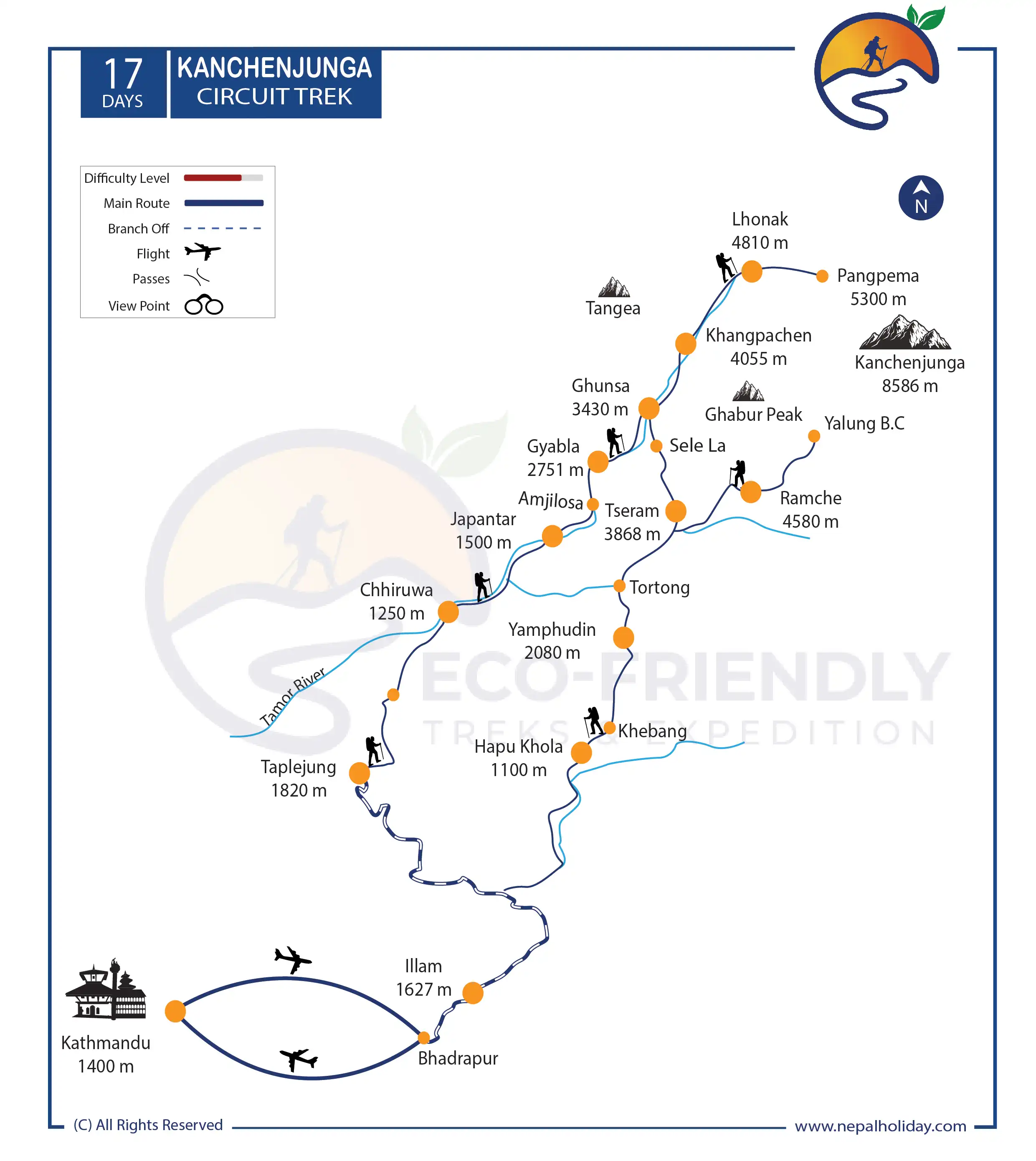 Download Map
Includes/Excludes
What's Included?
- Bus Fare during the trek
- Domestic Flights
- Permit Cards Expenses
- Experienced Himalayan trek guide for 17 days
- One porter for two of you for trekking for 13 days (prepare to give max. 15 kgs’ luggage from each of you so that it will not exceed 30 kg. for your porter)
- Basic yet comfortable accommodation for 16 nights on a twin-sharing basis during the trekking as per itinerary.
- Staff insurance
- 16 x set breakfast, 16 x set lunch and 16 x set dinner while on the trek
- Purified drinking water during the entire trekking as per itinerary
- General first aid medicine kit
- Complimentary T-shirt
- Duffle bag during the trek
What's Excluded?
- International Flight Fare
- Accommodation in Kathmandu since there are many possibilities available.
- Personnel expenses of any kind
- Any Travel Insurance
- Any additional cost due to natural calamity and unforeseen circumstances.
- Tips for any staff and guide
- Anything that is not listed in the “PRICE INCLUDES” section above
Essential Information - Kanchenjunga Circuit Trek- 18 Days | Itinerary | Cost | For 2025/26
Accommodation on Kanchenjunga Trek
The Kanchenjunga Trek accommodation is located in a remote area of the Himalayas. Basic facilities are available, such as toilets, bathrooms, and lodgings. While the other locations offer very basic amenities, Gunsa offers decent hotels with all the conveniences.
You will be given a typical twin-bedding room with minimal utilities, a blanket, a cozy mattress, and a sleeping bag if necessary.
Food on Kanchenjunga Trek
The most popular foods are Thukpa and Dal Bhat. Momo, macaroni, and spaghetti are also available in a few places. They might also have fresh goat meat. The most crucial component while trekking is food. Your health depends on the type of food you eat because there are many possibilities for sickness at high altitudes.
Eating high-calorie food that keeps you energized during the day would be best. Avoid alcohol and foods that lead to dehydration. Here on the Kanchenjunga Circuit Trek route, there is a limited selection of food options, and not every item on the menu will be fresh. To be active and prepared to walk, it is necessary to choose what you should and should not eat.
The best season to trek Kanchenjunga
Early March to mid-May and late October to early November are the ideal times to go trekking in the Kanchenjunga region. This region’s main hiking routes are in and out of numerous valleys. And in the lower reaches of these valleys, at the beginning and end of the trekking season, it may get rather hot.
The monsoon season, which lasts from around late May to mid/late September, is something we advise avoiding. The only choice in the bitterly cold winter months will be to camp because locals will go to lower altitudes and teahouses will be closed.
Related Article: Best Time to Trek in Nepal
Altitude Sickness & Acclimatization of Kanchenjunga Trek
Altitude sickness is one such problem in the high-altitude region. The Kanchenjunga Base Camp Trek is a high-altitude trek and reaches above altitude of 5200m. Significant issues arise because of this during the trek.
With elevations ranging from 1,270 to 5,300 meters above sea level, the Kanchenjunga Circuit Trek offers unique scenery. Acclimatization is, therefore, essential and must not be skipped. There will be fewer air particles pushing downward pressure as you rise higher. As you ascend, the distances between air particles begin to increase.
It would help if you were also physically fit, so we ask you to engage in physical activities for three months before the trek.
Kanchenjunga Trek Packing Suggestions
Please properly pack your luggage for the porter (each of you weighs 15kg; for two of you, a porter is arranged). You will leave the rest of your luggage behind at your hotel until the end of this holiday. Below is a loosely advised Kanchenjunga Trek packing list that might help you on your trek:
- Appropriate clothing (3 sets)
- Woolen sweater or jacket
- Thermal inner wear
- Wide-brimmed hat
- Woolen cap and scarf
- Thick woolen gloves
- Water-proof gloves
- Sport Sandals
- Woolen socks (2 pairs)
- Water-proof (not water-resistant) shoes with a good tread or grip
- Rain-proof pants and jacket with hood
- A lock for the duffle bag
- Backpack with water-proof cover
- Sleeping bag suitable for temperatures around 0°C (optional)
- Down jacket with hood
- Camera (optional) (video camera is not permitted by authority)
Other essential items:
- Personal clothing
- Toiletries
- Small thermos for hot beverages
- Water bottle (1 liter)
- Sunscreen lotion (50 SPF or more)
- Castor oil (50 ml) to lubricate the nostrils at high altitude
- Ziplock bags for clothing
- Quick-dry Towel (not a regular one)
- Toilet paper
- Wet wipes
- Sunglasses
- Snacks – chocolates, biscuits, nuts, etc.
- Hand sanitizer
- Powerful flashlight or headlamp (with extra batteries)
Medical Kit
Though we arrange basic medical kits for Kanchenjunga Circuit Trekking, they are very general and may not be adequate based on conditional necessity. Personal medical equipment with electrolyte packs, pain killers, muscle relaxant cream, band-aids, knee caps, medicines for fever, common cold, headache, nausea, vomiting, diarrhea, indigestion, and any other personal medication is necessary from your side.
Communication in Kanchenjunga Trek
Kanchenjunga Circuit itinerary encounters different landscapes. Even in this age of highly modern information and communication technologies (ICT), the landscapes are challenging to approach development in remote areas. One cause of this is still not correctly developing the technologies. As communication is significant in such an area, a guide has a mobile that may help connect you with a networked site. The lodges also have telephones you can call for a specific price. Wi-Fi may be available in very few places on this route.
Most asked questions
FAQs about Kanchenjunga Circuit Trek- 18 Days | Itinerary | Cost | For 2025/26
It has been known for decades that living in the Himalayas, like Kanchenjunga or others, enables one to realize a joyful wholeness within oneself. Your existence in the mountains, forests, or any other natural existence is associated with the attainment of completeness within you.
Himalayan or mountain ranges and hermits in the forest are topics of Zen to Jesus. Himalayas have the ability to bring together unnecessary divides and facilitate joyous recreation. Never undervalue the special interests you hold; they may be so intense that they might help you reach your potential and convert you into a complete person.
We sincerely believe that the Kanchenjunga Treks is more than just a holiday in consideration of this; nonetheless, your level of interest and awareness will determine how you will experience it.
Kanchenjunga North Base Camp, 5,143 meters (16,873 ft) above sea level, marks the highest point of the Kanchenjunga Trek.
As previously said, Kanchenjunga Base Camp is a challenging journey, although it is highly achievable for those in decent physical shape. This walk may very well be for you if you are physically fit, have considerable stamina, and have a strong desire to accomplish something remarkable.
It is among the hardest high-altitude hikes in Nepal. Trekkers must travel over remote high-altitude paths for many days and traverse passes between 4,000 and 5,000 meters high.
The trek is yet not suggested if this is your first time in high altitude. This hike is challenging. Challenging means you have to navigate a variety of mountain passes while enduring challenging ascents and descents. Also, this walk is challenging due to the required length of time.
For various reasons, permit cards have been mandatory in most Nepal trekking destinations. First, it is directly connected to your safety while walking in the protected areas. The trekkers’ security and safety are maintained due to this authorization. The information can enable the authorities to assist you in any crises, such as earthquakes, landslides, etc. Additionally, it aids in maintaining the national park’s laws and regulations.
You must issue two permits for the trek Kanchenjunga Conservation Area Project Entry Permit (KCAP) and a Restricted Area Entry Permit. Our team will help you by giving the permit for you.
Is it possible to extend or reduce the Kanchenjunga Circuit Trek Itinerary?
The package we have designed can be changed, increased, decreased, or otherwise modified. For the change, we request you to make a direct inquiry. Our team is happy to turn your ideal package into a reality.
The schedule we provide is also one of the shortened itineraries of the region that we have created, taking health and other considerations into account. High altitude sickness and other problems may result from insufficient time to adjust to changing temperature, humidity, or pH. If you are highly new to high elevations, cutting your journey days short could be unhelpful for your body.
But, if you wish to extend your time in the Kanchenjunga Region, we provide the best alternative options for developing the days and tailoring your itinerary to suit your demands. Please do not hesitate to get in touch with us; we will put together your ideal package with the help of our team and you.
It would be best if you went with a Kanchenjunga Trek guide to buy the package from us. We are sorry to inform you that booking from us, taking a guide with you, is mandatory. When you book a local company like us, we are concerned about your security. Throughout your journey, you will always have someone experienced to provide the greatest recommendations.
We highly suggest you go along with a trekking agency to hire a guide on any trekking route, especially if you are traveling to high elevations for the first time.
You will have trained experts at your side to keep an eye on your symptoms right away. They will help you learn at every step because they are experienced with such high elevations and fauna. If you are traveling with a guide, the group will always provide you with a greater selection of lodging, food, and other necessities to make your walk easier overall.
There are severe electrical issues in these remote locations, and power outages are frequent. If you wish to use electricity, you must pay additional rupees. However, we suggest you carry a power bank and an extra battery.
Nowadays, travelers like you also carry smaller, foldable solar chargers that let them charge their devices while walking. It is essential to have these things on hand in case of power outages or low voltage.
It is essential to check health and fitness when traveling through high-altitude regions. It helps to ensure a safe and comfortable experience for all the trekkers.
As previously said, Kanchenjunga Base Camp is a challenging journey. However, it is highly achievable for those with considerable stamina and a strong desire to accomplish something remarkable.
We are pleased to have you visit the Kanchenjunga Himal trek with kids and family since we think nature benefits children in various ways. The journey may be completed without incident with a qualified guide.
For at least two months, get your kids in shape for this walk by having them practice easy exercises and breathing techniques. Please let us know during the inquiry if you require a kid carry service. We provide it for the extra safety of the kid in case s/he cannot walk these few days.
We want to inform you that before starting your journey to Kanchenjunga Circuit Trek, we already pay on several things on your behalf: permit, taxes, and others. Please also be aware that we must compensate our porters and guides even if you cancel or choose not to finish the trip because of their commitment to serving you.
Specific fees apply if you desire to cancel your reserved trips. Behind that, we welcome you to shift your trip days to Kanchenjunga Circuit trekking or the package itself. We may charge a specific amount of money if you wish to reschedule/cancel the booking date. Both parties will benefit if you inform us as soon as possible. Please go through our terms and conditions to clarify the refund process.
In case of hikers finish their journey sooner than expected or decide to terminate it early for any reason, kindly be aware that we do not grant refunds for any portion of the trek that is not used. This also totally depends on the circumstances, but we request that you not expect a refund for the above-mentioned reasons.
Starting three months of your vacation, we strongly advise you to get active to mentally and physically prepare yourself. Additionally, we offer the Soldhunga Hike as part of our quick acclimation training trip. You can utilize this hike as a very tiny preview of what to expect on your main journey in the existence of the central Himalayas.
We highly welcome you to the Soldhunga hike if you reach Nepal a few days before your main trip.
We request that you ask our ground team in Kathmandu for assistance in arranging day tours around the city. If you still have an extra few days or a week after the trek, we can also arrange one of the following quick relaxation trips. Feel free to pick the one you think will best suit your interests.
- Pokhara
- Lumbini
- Ghandruk
- Chitwan Safari
These additional vacation days were planned to relax after a long trek rather than hiking again. Please let us know if there are any other destinations you would like to visit over these.
Reviews on Kanchenjunga Circuit Trek- 18 Days | Itinerary | Cost | For 2025/26


Based on 2
Reviews

Jenifer D.S
New Zealand
An adventure of a lifetime! Eco-friendly Treks made it all possible.
The team are very helpful and experienced the porters were great and helpful but good if they could speaks little better english. Some lodge are very basic but the experience is good. We love the nature and for trekking, we can recommend Nepal to everyone.
We are impressed, especially with the people in the village because they all are friendly.
The service and organisation were perfect and worth the money. Krishna was always there for us + organised everything. It was our first organised trek and thanks to Eco-friendly Treks a perfect and good experience.

Bartholomew Cronin
Oxford, UK
From start to finish, Nepal Holiday ensured our safety and enjoyment
The airport pickup was satisfactory and there is no delay in transferring to the hotel. The hotel in Katmaneus is not soo good and has no hot water. The trip guide and other crew members are very helpful and great on the trail. The scenery during the trip and experience with nature were top-notch.
The local people and cultural experience were very good. I have a big hotel. I can send you many clients. I will do Makalu and Chitwan next.